AI voice agents for small business in 2026: the n8n + Vapi playbook
An AI voice agent for a small business in 2026 costs roughly US$0.11–0.25 per minute all-in, about $110–250/month at typical volume, versus ~$3,000–4,000/month for a full-time receptionist. NexFlow's packaged AI receptionist is the same job with a calendar and CRM behind it. The build that matters isn't the voice; it's the n8n workflow behind it that checks your real calendar, books the appointment, logs the call, and escalates to a human. Compliance is the part most tutorials skip: in the US the FCC's TCPA ruling treats AI voices as "artificial" and 12 states require all-party consent to record; the UK has PECR/ICO, and the EU AI Act (Article 50) forces AI disclosure from 2 Aug 2026. Here's the platform comparison, the one disclosure line that covers all of it, and the export-ready workflow.
The fastest-growing question in our inbox this quarter isn't about chatbots anymore, it's "can you build us an AI that answers the phone?" The search data agrees: "ai voice agent for small business", "ai voice agent pricing", and "ai voice agent for real estate" are all climbing. The technology finally crossed the line from gimmick to useful somewhere in late 2025: response latency dropped under a second, the voices stopped sounding robotic, and, crucially, the agents learned to let you interrupt them.
Most of the content out there is either a platform's own sales page or a Fiverr gig. This is the engineer's version: what it actually costs, the rules you have to follow (which differ by country, and the US ones bite hardest), which platform to pick, and the exact n8n workflow that turns a 7pm missed call into a confirmed Tuesday-morning appointment, without a human touching it.
What an AI voice agent actually costs (the "ai voice agent pricing" question, answered honestly)
Every platform advertises a headline per-minute rate that is technically true and practically useless, because the headline only covers one layer. A real call needs four moving parts you pay for: speech-to-text (transcribing the caller), the LLM (deciding what to say), text-to-speech (the voice), and telephony (the actual phone number and minutes). The platform is the orchestration glue on top.
Here's where the real numbers land in 2026. Vapi advertises from US$0.05/min for orchestration, but once you add the components, production setups run roughly US$0.07–0.25/min, and a fully-loaded configuration can reach US$0.30–0.33. Retell starts at US$0.07/min, and a standard deployment with GPT-4o, Deepgram speech-to-text, and ElevenLabs voice lands around US$0.11–0.15/min. The honest planning number for an SMB is US$0.11–0.25 per minute, all-in.
Translate that to a monthly budget. A small business handling 1,000 minutes a month, call it 500 calls at two minutes each, a busy clinic or trades office after-hours line, spends roughly US$110–250/month on the agent, plus a phone number (a few dollars) and the n8n that orchestrates it (from free self-hosted; see our Hetzner setup). Compare that to the alternative:
| Option | Monthly cost (≈ USD) | Hours covered | Notes |
|---|---|---|---|
| Full-time receptionist (US) | $3,000–4,000 | ~40/week | Plus benefits, PTO, training, sick days. Comparable to £2,200–2,900 / €2,600–3,400 in the UK/EU. |
| Phone answering service | $200–1,500 | Variable | Per-call or per-minute, often offshore, no calendar write |
| AI voice agent (1,000 min) | $110–250 | 24/7 | Books into your calendar, logs every call, escalates on request |
That's the 85–95% cost reduction the platforms quote, and for once the marketing is roughly right for routine call handling. The honest caveat: an AI agent is not a replacement for a skilled human handling a distressed customer or a complex negotiation. It's a replacement for voicemail, for the after-hours gap, and for the overflow when your one receptionist is already on another line. That's where it pays for itself in week one.
Is this legal? The compliance map: US first, then UK, EU, and the rest
This is the part most overseas tutorials skip, and it's the part that can cost you real money. The rules differ by where your callers are, and they're tightening everywhere. Work through them in the order your customers actually live in.
United States: the TCPA + state two-party consent (the strictest, design for it first)
Two layers matter in the US. First, the FCC's February 2024 declaratory ruling confirmed that AI-generated voices are "artificial" under the Telephone Consumer Protection Act (TCPA). They're not banned, but they're governed like any artificial or pre-recorded voice call: for outbound or marketing calls you need prior express consent, a clear AI-use disclosure at call time, and an easy human handoff. (By February 2026 the FCC's Robocall Mitigation Database also added penalties, a $10,000 base forfeiture for false filings, so the enforcement teeth are real.)
Second, call recording is state law. Federal baseline is one-party consent, but 12 states require all-party (two-party) consent, California, Connecticut, Delaware, Florida, Illinois, Maryland, Massachusetts, Montana, New Hampshire, Oregon, Pennsylvania, and Washington. Florida treats a violation as a felony (up to five years). If your callers can come from anywhere in the country, the only sane design is to record to the strictest standard: disclose and get agreement on every call. Do that once and you're compliant in all 50 states.
United Kingdom: PECR, the ICO, and Ofcom
UK AI calling sits under PECR (administered by the ICO), UK GDPR, and Ofcom's nuisance-call rules. PECR splits calls into "live" and "automated"; a conversational AI with a human handoff may be treated more like a live call, but the regulator hasn't formally resolved the gray zone, so don't assume the lenient reading. The ICO's January 2026 guidance now expects a documented Legitimate Interest Assessment (LIA), explicit disclosure of AI-assisted call analysis, and automated retention/deletion. The stakes rose: the Data (Use and Access) Act 2025 aligned PECR penalties with UK GDPR, so serious breaches can now reach £17.5 million or 4% of global turnover.
European Union: the EU AI Act, Article 50
From 2 August 2026, Article 50 of the EU AI Act is enforceable: any AI system that interacts directly with a person in the EU, every chatbot, every voice agent, must disclose its non-human nature at the point of interaction, at the first interaction, in the language of the call. The exception is where the AI nature is already obvious. The penalty ceiling is €15 million or 3% of global turnover. Layer GDPR on top: the transcript and anything the caller shares is personal data needing a lawful basis, retention limits, and care with cross-border transfers.
The convenient truth: a single opening line satisfies the US FCC AI-disclosure rule, US two-party recording consent, the EU AI Act Article 50 disclosure, and the UK expectations at once, "Hi, you're speaking with [business]'s AI assistant. This call may be recorded for quality and record-keeping, is that okay?" Make it the mandatory first utterance, capture the yes/no, and log it. That one sentence is the cheapest compliance you'll ever ship. Other markets (Canada's CRTC, Australia's 1 Jan 2026 all-party rule with penalties to $110k, and similar regimes) layer on top, but they all reward the same up-front disclosure pattern.
Vapi vs Retell vs the rest (which platform for an SMB)
The 2026 field is crowded, Vapi, Retell, Synthflow, Bland AI, and PolyAI are the names that come up most, but for an SMB the choice usually narrows to two: Vapi and Retell.
Retell is the simpler, slightly cheaper, more managed path. If what you want is a reliable receptionist that answers, books, and escalates, Retell gets you there with fewer moving parts and a lower effective per-minute cost. Vapi gives technical teams more control, you choose every component in the voice pipeline and can build unusual call logic, at a higher all-in price once everything's wired. Synthflow and Bland sit around the same space with different trade-offs; PolyAI targets larger contact-centre deployments and is usually overkill for an SMB.
Here's the key architectural point that makes the platform choice reversible: in our builds, the voice platform is just the mouth and ears. All the business logic, checking the calendar, booking, logging, escalating, lives in n8n behind webhook tools. That means you can start on Retell and move to Vapi (or vice versa) by re-pointing the webhook URLs, without rebuilding a single piece of your actual workflow. Never let the voice vendor own your business logic.
The build: from inbound call to booked appointment
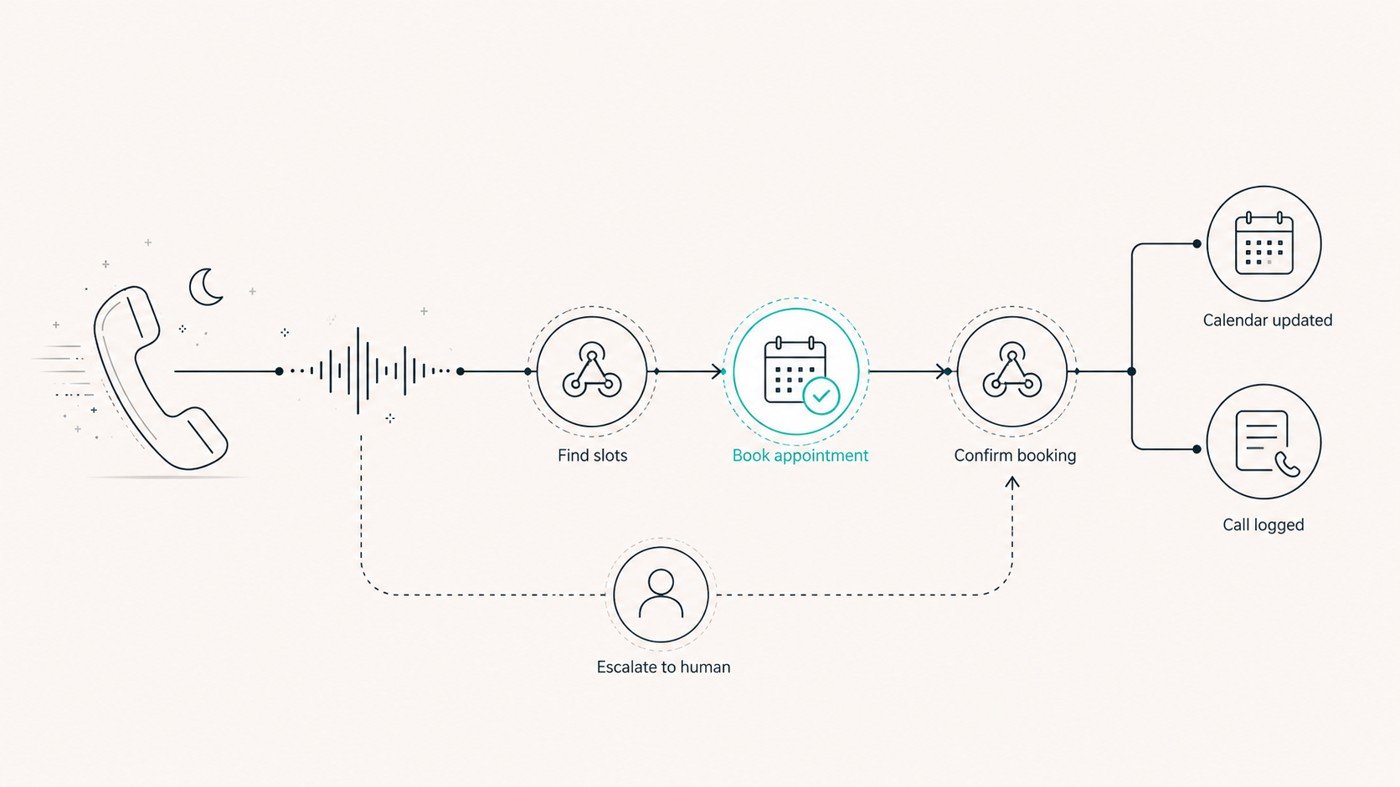
Here's the workflow we ship most. The voice platform handles the conversation, but during the call it invokes tools, webhooks that hit n8n. The n8n side template (the popular Vapi + Google Calendar + Airtable pattern) exposes a handful of tools the agent can call mid-conversation: GetSlots, BookSlots, UpdateSlots, CancelSlots, and an end-of-call report webhook that fires once the call ends.
The flow, end to end:
- 1 Caller dials your number. The voice platform answers, runs the disclosure line ("you're speaking with an AI assistant, the call may be recorded…"), and captures consent.
- 2 Caller asks for an appointment. The agent calls the
GetSlotswebhook → n8n queries Google Calendar for free times → returns the next three openings. - 3 Caller picks a time. The agent calls
BookSlots→ n8n creates the calendar event, with the caller's name and number in the description. - 4 Call ends. The platform fires the end-of-call report → n8n parses the transcript, extracts the caller's intent and details with a cheap model (GPT-4o-mini does this well), writes a row to Airtable, and sends an SMS/email confirmation.
- 5 Low confidence or explicit request. The agent escalates, warm-transfers to a mobile or books a callback, so a human always has the override.
The n8n side of the BookSlots tool is just a webhook → calendar write → respond. Export-ready shape:
{
  "name": "Voice Agent — BookSlots tool",
  "nodes": [
    {
      "parameters": {
        "httpMethod": "POST",
        "path": "voice/book-slot",
        "responseMode": "responseNode"
      },
      "type": "n8n-nodes-base.webhook",
      "typeVersion": 2,
      "name": "Vapi Tool Call",
      "position": [240, 300]
    },
    {
      "parameters": {
        "operation": "create",
        "calendar": "primary",
        "start": "={{ $json.body.start }}",
        "end": "={{ $json.body.end }}",
        "summary": "=Appt: {{ $json.body.caller_name }}",
        "description": "=Booked by AI voice agent. Phone: {{ $json.body.caller_phone }}. Consent to record: {{ $json.body.consent }}"
      },
      "type": "n8n-nodes-base.googleCalendar",
      "typeVersion": 1,
      "name": "Create Event",
      "position": [520, 300]
    },
    {
      "parameters": {
        "operation": "create",
        "base": "={{ $env.AIRTABLE_BASE }}",
        "table": "Calls",
        "columns": {
          "caller_name": "={{ $json.body.caller_name }}",
          "phone": "={{ $json.body.caller_phone }}",
          "booked_for": "={{ $json.body.start }}",
          "consent_to_record": "={{ $json.body.consent }}"
        }
      },
      "type": "n8n-nodes-base.airtable",
      "typeVersion": 2,
      "name": "Log Call",
      "position": [800, 300]
    },
    {
      "parameters": {
        "respondWith": "json",
        "responseBody": "={ \"status\": \"booked\", \"start\": \"{{ $json.body.start }}\" }"
      },
      "type": "n8n-nodes-base.respondToWebhook",
      "typeVersion": 1,
      "name": "Respond to Vapi",
      "position": [1080, 300]
    }
  ],
  "connections": {
    "Vapi Tool Call": { "main": [[{ "node": "Create Event", "type": "main", "index": 0 }]] },
    "Create Event":   { "main": [[{ "node": "Log Call", "type": "main", "index": 0 }]] },
    "Log Call":       { "main": [[{ "node": "Respond to Vapi", "type": "main", "index": 0 }]] }
  }
}
Two production notes from shipping these. First, the response has to come back fast, the caller is on the line listening to silence while n8n thinks. Keep the BookSlots path to a single calendar write and respond immediately; do the Airtable logging and confirmation SMS asynchronously after the response, or the caller hears an awkward pause. Second, idempotency matters: voice platforms retry webhooks on timeout, and a double-fire means a double booking. Key the calendar write on a call ID so a retry updates rather than duplicates, the same discipline from our error-handling playbook.
The system prompt: the part that decides whether it sounds human
The single biggest difference between an agent callers tolerate and one they hang up on isn't the voice, it's the prompt. Three rules we've learned the hard way after listening to a few thousand recordings.
Keep turns short. A long-winded agent feels like being held hostage. We instruct the model to ask one question at a time and never deliver more than two sentences before handing the turn back. Confirm the slot, not the essay. When booking, the agent reads back only the date, time, and name, "Tuesday the 23rd at 10am for Sara, correct?", not a paragraph. And give it a hard escalation rule: any sign of frustration, any request for a human, or two failed attempts to understand, and it transfers. A compact opening prompt that bakes in the mandatory disclosure (which satisfies the FCC and EU AI Act at once):
You are the after-hours receptionist for {{business_name}}.
FIRST, before anything else, say exactly:
"Hi, you're speaking with {{business_name}}'s AI assistant.
 This call may be recorded for quality and record-keeping —
 is that okay?"
If the caller declines recording, continue without recording.

Rules:
- Ask ONE question at a time. Max two sentences per turn.
- To book: call GetSlots, offer up to 3 times, then call BookSlots.
- Read back ONLY date, time, and name to confirm.
- If the caller is upset, asks for a human, or you fail to
  understand twice: say you'll connect them and call Escalate.
- Never invent availability. Never quote a price you weren't given.
The other half is latency. Callers read a pause longer than about a second as "the line dropped." Two levers fix most of it: use a fast, cheap model for the conversational turns (the heavy reasoning lives in your n8n tools, not the voice loop), and make sure your webhooks respond fast, which is exactly why the BookSlots flow above responds before it logs. Enable barge-in (let the caller interrupt) so the agent stops talking the instant the human starts. Get those right and the "it sounds robotic" complaint mostly disappears.
Where it earns its money (real estate, trades, clinics)
The "ai voice agent for real estate" search isn't an accident, it's one of the highest-ROI cases, and it's huge in the US and UK markets. An agent who's at a showing can't answer the phone, and a missed call from a buyer is a missed commission. A voice agent answers, qualifies (buying or selling? area? timeframe?), books the showing or valuation into the calendar, and texts the human agent the summary before they're back in the car. We covered the data side of this in the real-estate lead pipeline; voice is the front door to it.
Trades are similar, a plumber on a job can't pick up, and the next caller just rings the competitor. The voice agent captures the job, the address, the urgency, and books a slot. Clinics use it for the after-hours and overflow gap, where it doubles as no-show insurance (the same pattern that recovered 9.1 slots a week for the clinic we wrote up in our no-show automation case study). The common thread: businesses where the owner is the front desk, and every missed call is lost revenue, not just a missed message.
- Plan on US$0.11–0.25/min all-in (≈ $110–250/month at 1,000 minutes), 85–95% cheaper than a receptionist for routine calls. It replaces voicemail and overflow, not your best human.
- US compliance is the strictest, design for it. The FCC's TCPA ruling treats AI voices as "artificial" (consent + disclosure + human handoff), and 12 states require all-party recording consent. Record to the strictest standard and you're covered nationwide.
- UK: PECR + UK GDPR + Ofcom; ICO's Jan 2026 guidance wants an LIA and AI-analysis disclosure; penalties now reach £17.5M / 4%.
- EU: AI Act Article 50 forces AI self-disclosure from 2 Aug 2026 (ceiling €15M / 3%). One opening line covers US + EU disclosure at once.
- Retell = simpler, cheaper, managed; Vapi = more control, higher all-in. For most SMBs, Retell is the faster receptionist.
- Keep business logic in n8n behind webhook tools (GetSlots / BookSlots / end-of-call report) so the voice platform stays swappable. Respond to the booking webhook immediately, log asynchronously, and make writes idempotent to avoid double bookings.
- Highest-ROI cases: real estate, trades, and clinics, anywhere the owner is the front desk and a missed call is lost revenue.
A one-week path to a live voice agent
- Day 1, pick the lane. One use case: after-hours reception, or overflow, or outbound follow-up. Don't try to do all three first.
- Day 2, platform + number. Spin up Retell (or Vapi), buy a phone number, get a "hello, you're speaking with an AI" call working end to end with the consent disclosure as the first line.
- Day 3, the tools. Build the GetSlots and BookSlots n8n webhooks against a test calendar. Confirm the agent can read availability and write an event.
- Day 4, the safety net. Add escalation (warm transfer to a mobile) and the end-of-call report → Airtable log. Test a retry to prove no double booking.
- Day 5, compliance pass. Verify the disclosure line fires first, the consent decision is logged, and you know where the transcript data lives (and whether any of it crosses a border).
- Day 6, shadow it. Forward only after-hours calls to the agent for a day. Listen to every recording. Fix the three things that sound wrong.
- Day 7, go live on the gap. Point your missed-call / after-hours flow at it. Keep the human override one sentence away.
Want a voice agent that books real appointments?
NexFlow builds the whole loop, the voice agent, the n8n tools that read your calendar and book the slot, the Airtable log, the escalation path, and the TCPA / GDPR / AI-Act-ready disclosure and consent capture, on infrastructure you own. Start with a 15-minute map call and we'll tell you honestly whether voice is worth it for your call volume.
Sources & method
- Per-minute pricing, Retell AI and Vapi 2026 pricing breakdowns (Retell base US$0.07/min; Vapi base US$0.05/min; loaded setups US$0.11–0.33/min).
- Cost comparison, voice-platform virtual-receptionist analyses, 2026 (85–95% cheaper than a full-time receptionist for routine handling).
- n8n workflow template, "Automate call scheduling with Voice AI receptionist using Vapi, Google Calendar & Airtable" (GetSlots / BookSlots / UpdateSlots / CancelSlots + end-of-call report).
- US, FCC Declaratory Ruling FCC 24-17 (Feb 2024): AI-generated voices are "artificial" under the TCPA; prior express consent, disclosure, opt-out/human handoff. Robocall Mitigation Database penalties (2026). Ruling: fcc.gov.
- US, two-party (all-party) call-recording consent states (2026): CA, CT, DE, FL, IL, MD, MA, MT, NH, OR, PA, WA. Federal baseline = one-party.
- UK, PECR + UK GDPR + Ofcom; ICO updated guidance (Jan 2026, LIA + AI-analysis disclosure); Data (Use and Access) Act 2025 penalty alignment (£17.5M / 4%). Guidance: ico.org.uk.
- EU, EU AI Act Article 50 transparency obligation, enforceable 2 Aug 2026 (ceiling €15M / 3%); European Commission Code of Practice on Transparency of AI-Generated Content (10 Jun 2026). Text: artificialintelligenceact.eu/article/50.
- Field experience from NexFlow voice-agent builds, Q2 2026.